February 13, 1633
Galileo arrives in Rome for trial before Inquisition
from Oxford Univ Press
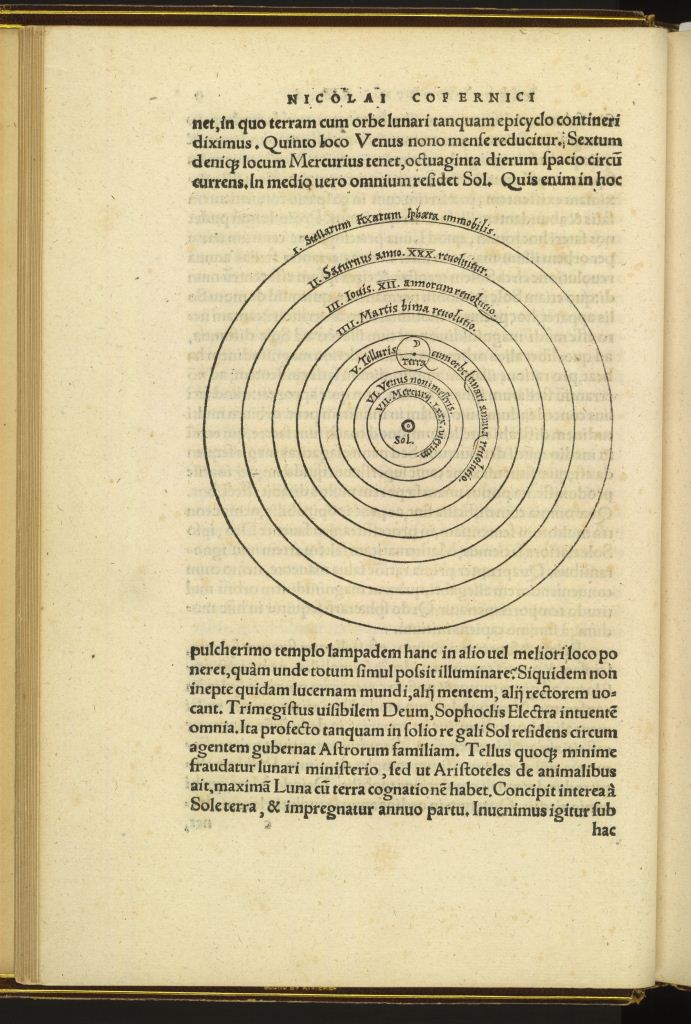 Sixty-nine years old, wracked by sciatica, weary of controversy, Galileo Galilei entered Rome on February 13, 1633. He had been summoned by Pope Urban VIII to an Inquisition investigating his Dialogue Concerning the Two Chief World Systems. The charge was heresy. The cause was Galileo’s support of the Copernican theory that the planets, including Earth, revolved around the sun.
 Nicolas Copernicus had published his heliocentric theory in 1543. His ideas were condemned by religious leaders — not only Catholic ones but also Protestants Martin Luther and John Calvin — because they contradicted the Bible. Slowly, though, astronomers began to accept the sun-centered universe.
Galileo’s own acceptance, forged in the 1590s, grew stronger in 1609, when he used a new invention, the telescope, to study the planets. Discovering that the Moon had craters, Jupiter was orbited by moons, and Venus had phases like the Moon, he rejected the accepted belief that the heavens were fixed, perfect, and revolving around Earth. more
33 years earlier
-Cambridge Univ Press
Giordano Bruno
Cambridge, 1998
195 B898c
excerpt:
On Magic
"The bondings of the imagination would not be very significant in themselves if they did not duplicate the powers of thought, for those appearances which bind and obligate the souls of those who are simple-minded, stupid, credulous and superstitious, are derided and condemned as empty shadows by those who have a sober, disciplined and well-bred mind. As a result, all practitioners of magic, medicine and prophesy produce no results without a pre-given faith, and unless they act according to the rules of faith..."
related:

Ioan P. Couliano
University of Chicago, 1987
133.4094 C967e
It is a widespread prejudice of modern, scientific society that "magic" is merely a ludicrous amalgam of recipes and methods derived from primitive and erroneous notions about nature. Eros and Magic in the Renaissance challenges this view, providing an in-depth scholarly explanation of the workings of magic and showing that magic continues to exist in an altered form even today.
Renaissance magic, according to Ioan Couliano, was a scientifically plausible attempt to manipulate individuals and groups based on a knowledge of motivations, particularly erotic motivations. Its key principle was that everyone (and in a sense everything) could be influenced by appeal to sexual desire. In addition, the magician relied on a profound knowledge of the art of memory to manipulate the imaginations of his subjects. In these respects, Couliano suggests, magic is the precursor of the modern psychological and sociological sciences, and the magician is the distant ancestor of the psychoanalyst and the advertising and publicity agent.
In the course of his study, Couliano examines in detail the ideas of such writers as Giordano Bruno, Marsilio Ficino, and Pico della Mirandola and illuminates many aspects of Renaissance culture, including heresy, medicine, astrology, alchemy, courtly love, the influence of classical mythology, and even the role of fashion in clothing.
new in Lit:

Marsilio Ficino
Inner Traditions, 1997
186.4 F446m
The problems that taxed the minds of people during the Renaissance were much the same as those confronting us today. In their perplexity many deep-thinking people sought the advice of Marsilio Ficino, the leader of the Platonic Academy in Florence, and through his letters he advised them, encouraged them, and sometimes reproved them. Ficino was utterly fearless in expressing what he knew to be true. His letters cover the widest range of topics, mixing philosophy and humor, compassion and advice, and offering a profound glimpse into the soul of the Renaissance.
-publisher